Case 04 · Consumer AI · Native iOS + API
A paid-report product path designed around visible value—not borrowed certainty.
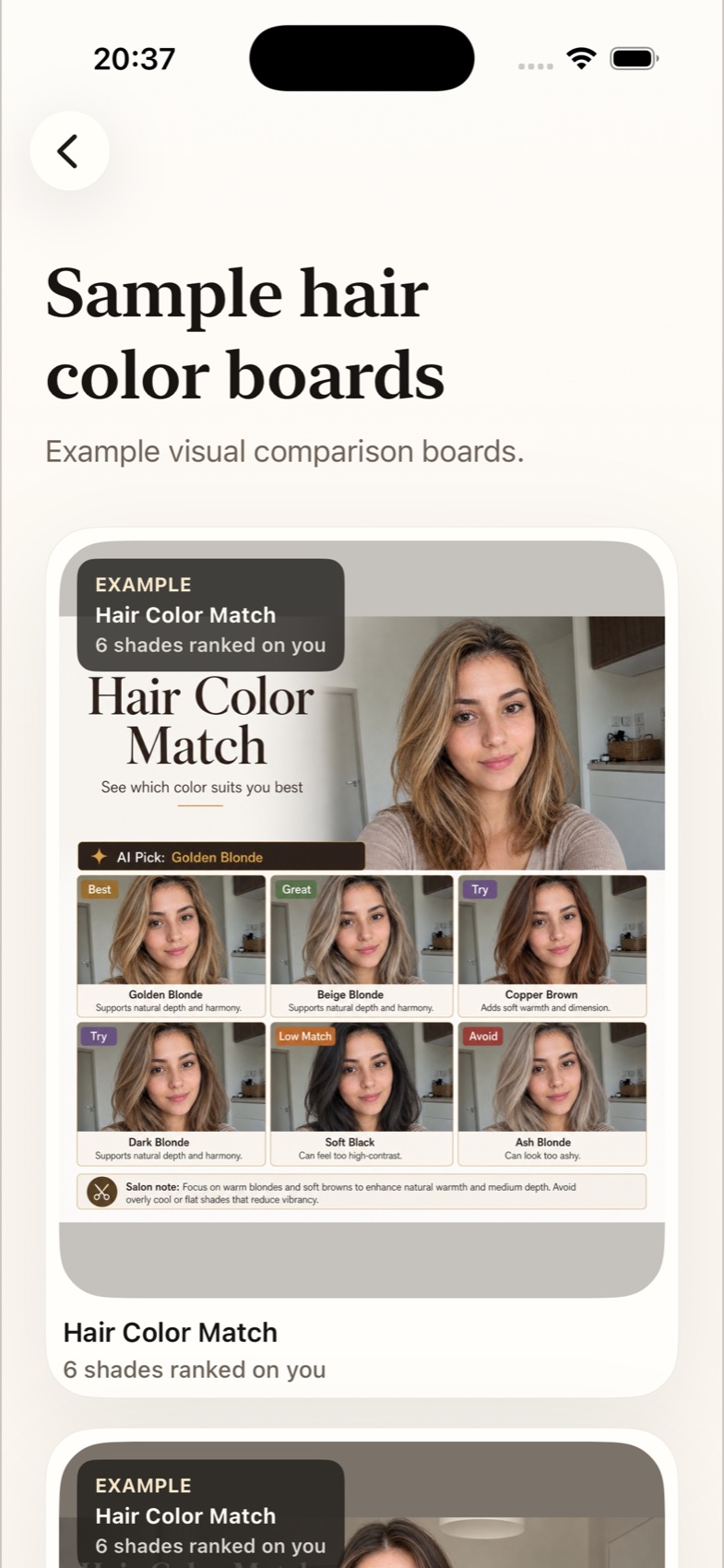
Style intelligence turns a photo-led analysis workflow into a decision-ready comparison: a native product experience, structured result and commerce path whose trust boundaries are visible before the user is asked to pay.
The result below is clearly labelled sample content. Evidence on this page covers implementation and test state, not public launch, revenue or real-user conversion.- 155
- backend tests passed
- DEBUG + RELEASE
- simulator builds passed
- SAMPLE
- generated report content labelled

01 / Product decision
Make the paid result useful before making it impressive.
A raw model response is not a product outcome. The experience has to help someone compare options, understand what informed the result and decide what to do next without treating generated advice as measured fact.
The product was shaped around that decision: a focused input, a visible value promise, a structured comparison report and an honest distinction between sample content, generated output and user-provided material.
02 / Trust boundary
Design uncertainty, sample states and human judgment into the interface.
Consumer AI becomes less trustworthy when confidence is hidden behind visual polish. Input quality, incomplete analysis, retries and sample reports therefore remain explicit product states rather than invisible implementation details.
The report is designed to support a personal decision, not replace it. It presents comparisons and reasoning in a form the user can inspect while avoiding a promise that the system can guarantee a real-world appearance.
- Sample content labelled
- Input and retry states
- Comparison-led result
- No guaranteed-outcome claim
03 / Product system
Connect the native experience, analysis workflow and commerce promise.
The SwiftUI client and FastAPI workflow were treated as one product contract. The interface defines what the analysis must return; typed result structure and deterministic cases keep presentation behavior testable when a live model or real user image is unavailable.
Commerce sits after the value structure is legible. That keeps the paywall promise attached to a coherent report rather than selling access to opaque model plumbing.
- SwiftUI product experience
- FastAPI workflow
- Typed result contract
- Paid-report value path
04 / Engineering evidence
State exactly what the current proof establishes—and what it does not.
The backend suite completed with 155 passing tests. Debug and Release simulator builds passed for the native app. These checks establish a reproducible implementation baseline across the report workflow and visible product states.
They do not by themselves prove App Store distribution, live payment configuration, production-model quality, conversion, retention or revenue. Those remain separate external and real-user validation gates.